
How To Whiten Your Teeth?
26 October 2024
Whitening is dentist-prescribed and starts with a check that your mouth is fit for it.
This is a guide to the right first appointment, not a diagnosis. Your dentist will talk through what is right for you once they have had a look.
Would rather just talk to someone? Call 01709 872292.
Fees are reviewed regularly. Please ask us for a current estimate.
It starts with a check that the teeth and gums are in a fit state for it, and an honest account of what it can change.
In the UK, tooth whitening can only legally be carried out by a registered dental professional, and only after a dentist has examined you. A beauty salon or a mobile technician offering it is breaking the law, whatever the price on the poster.
There is a reason for the rule beyond professional protectionism. Whitening an undiagnosed problem, decay, a leaking filling, gum disease, an untreated crack, can drive gel where it should not go and cause real damage. The examination is the point.
Products sold direct to the public are limited by law to a low concentration, which is why shop-bought kits do comparatively little. The stronger gel is available only through a dentist.
Cold sensitivity during and shortly after whitening happens to a lot of people and usually settles once you stop. Taking a break, or using it for shorter periods, generally helps.
How much change you see depends on your teeth and what caused the discolouration. Colour gradually returns over time, faster if you smoke or drink a lot of tea, coffee or red wine.
It is not suitable during pregnancy or breastfeeding, and is not carried out on under-18s except for specific clinical reasons. Some causes of discolouration respond poorly, and you should be told that up front.
Whitening starts with a check that your teeth and gums are in a fit state for it. Send an enquiry and reception will arrange that appointment.
How whitening works, why a shop kit does less, and what to expect while you are doing it.
A peroxide gel breaks down on the tooth and releases oxygen, which passes into the enamel and lightens the colour from inside it. Nothing is scraped, drilled or covered over, which is what makes whitening the gentlest thing on this whole section of the site.
It is gradual by design. The gel a dentist can supply is stronger than anything sold to the public, and it still works over two to four weeks rather than in an afternoon, because that is what lets it lift stain without damaging the tooth.
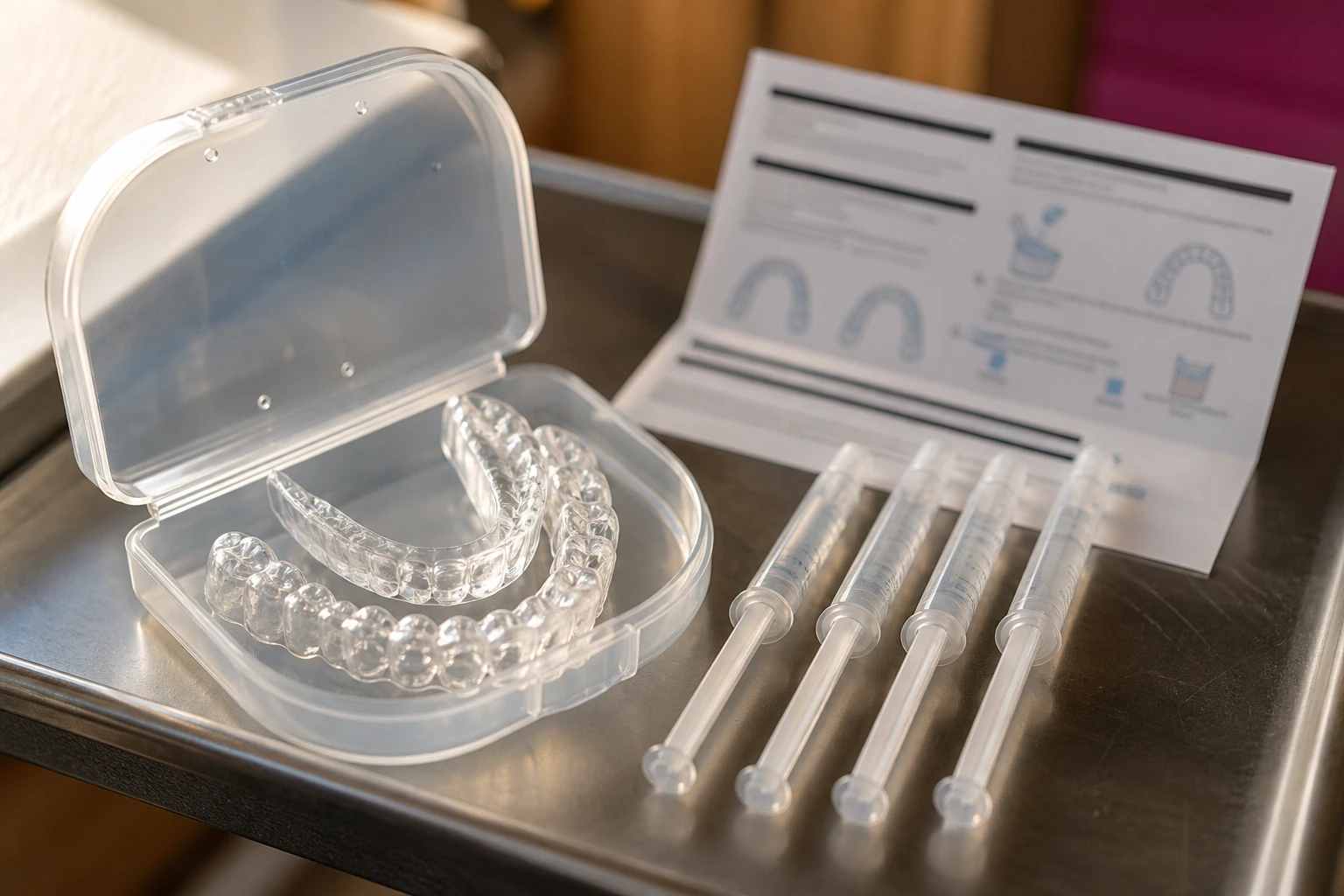
Two reasons, and the tray is the bigger one. A kit tray is a generic shape, so gel leaks out of it: into your mouth, where it irritates the gum, and away from the tooth, where saliva dilutes what is left. A tray made from an impression of your own teeth holds the gel against the tooth and nowhere else.
The gel is the second reason. Anything sold over the counter is limited by law to a concentration low enough to be sold unsupervised, which is why shop kits do comparatively little.
What you are handed here is custom trays, a case for them, written instructions, and a set of syringes in increasing strengths so the first few days are the mildest. Bring the trays to your annual check-up and they get looked over.
That depends on the colour they are now, what caused the discolouration, how dense the staining is, and what dental work you already have. Some causes of discolouration lift readily and some barely move.
Which is why the shades that are realistic for your teeth get shown to you at the consultation, against your own teeth, before you decide anything. A number promised in advance would be a guess.
Cold sensitivity during whitening is common and it is usually temporary, settling within a couple of days of stopping. There are four things that help, in roughly this order: wear the trays for a shorter period, take a day or two off, use a toothpaste for sensitive teeth, or move to a lower concentration of gel.
Mild gum irritation happens too, and when it does it is almost always the fit of the tray rather than the gel itself. That is fixable, so tell us rather than pushing on.
If either carries on after you have finished, get in touch.
Done properly, the effect is thought to last up to about three years, and it varies a great deal from person to person because it is mostly about what you put in front of your teeth afterwards.
In practice: somebody who smokes and eats a lot of staining food is looking at a top-up gel every three or four months. Somebody who does neither may go six months, or a year, or longer. You keep the trays either way, so a top-up is a few nights at home rather than a new course of treatment.
Less of what stains, mostly: tea, coffee, red wine, and smoking above all. Where you are having a staining drink anyway, a straw keeps it off the front teeth, which sounds fussy and works.
Then the ordinary things. Brush twice a day, clean between the teeth once a day, and use the top-up gel when the shade starts to drift rather than waiting until it has gone.
Come in for the check, hear what whitening can and cannot change, and leave knowing what it costs.

Book an appointment Call 01709 872292
Payment plans are available for larger treatment plans, subject to status and to the lender's terms. See how they work.